
Formula 1 has never been just a sport — it’s a high-speed laboratory where genius engineering, bold innovation, and a little bit of madness come together at 300 km/h.
Over the decades, some machines have done more than just win races; they’ve changed the direction of the entire sport.
These are the cars that made engineers rethink the rules, forced rivals to scramble back to the drawing board, and made fans like us stare at our screens wondering, “How on earth is that thing so fast?”
Whether you’re here for nostalgia, for the legends, or simply to admire the masterpieces that redefined performance, buckle in.
Here are the 10 greatest F1 cars ever built — the ones that didn’t just race history but wrote it.
Top F1 Cars of All Time
In case you didn’t know, these screamers and their sport, Formula 1, have a 70-year history.
Formula One cars are engineering marvels, and there have been some genuinely remarkable F1 cars of all time.
So, here are the fastest and top F1 cars, which we believe to be the greatest of all time.
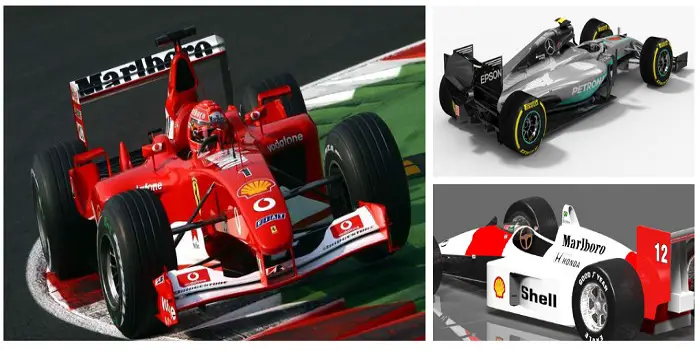
1. Mercedes F1 W07 Hybrid
The Mercedes F1 W07 Hybrid was the pinnacle of Mercedes’ success throughout F1’s hybrid V6 era.
The W07 was designed by John Owen under the technical guidance of Paddy Lowe and raced by Lewis Hamilton and Nico Rosberg in the 2016 season, which marked the pinnacle of the ‘Silver War’ between the two teammates.
Its chassis featured the characteristic “S-Duct” to improve airflow from the front to the back of the car, and it was upgraded during the season with ‘L-shaped turning vanes’ beneath the chassis and beside the bargeboards, as well as improved front wing fins to channel the airflow.
The F1 W07 Hybrid won 19 races (10 for Hamilton and 9 for Rosberg), 20 pole positions (12 for Hamilton and 8 for Rosberg), nine fastest laps (three for Hamilton and six for Rosberg), 14 front row lockouts, and eight 1–2 finishes, earning Mercedes the championship.
2. Ferrari F2002
The F2002 is a masterpiece from the Maranello stables, designed by chassis designer Rory Byrne under the technical guidance of Ross Brawn.
The car’s design concept was unique, with a small lightweight clutchless direct-shift gearbox, fluid traction control system, and periscopic exhaust outlets to regulate airflow.
It was powered by a 3.0-liter V10 engine and driven by Michael Schumacher and Rubens Barrichello that season, and it earned 11 poles, 15 victories, and 28 podiums, making it one of Ferrari’s most successful entrants ever, winning the F1 drivers’ and constructors’ championships.
3. McLaren MP4/4
The McLaren MP4/4, designed for Ayrton Senna and Alain Prost, is regarded as the F1 car that gave Senna his first championship.
The MP4/4 was one of F1’s most dominating cars, winning 15 races and claiming 15 poles while leading 1003 of 1078 laps.
The MP4/4 was designed by American engineer Steve Nichols under the technical guidance of Gordan Murray and was powered by an RA168 E 1.5-liter V6 turbo engine that produced over 700 BHP.
The dominating car won both the drivers’ and constructors’ championships in 1988, declaring the beginning of McLaren’s domination in F1.
4. Lotus 78
The Lotus 78 designed by Colin Chapman in 1977, was the first F1 vehicle to employ ground effects.
The automobile, which was inspired by the Havilland Mosquito fighter aircraft, had unusual wings beneath the car as well as on side skirts to channel underbody airflow, thereby turning the car into a large, inverted wing.
As a result, the 78 generated far greater downforce than cars with simply typical overhead wings.
The Lotus 78 driven by Mario Andretti and Gunnar Nilsson, won five races in 1977 and two more the following year before the Lotus 78 idea was modified to produce the Lotus 79, which went on to dominate the majority of the 1979 F1 season, with Andretti winning the drivers title.
5. Williams FW14
The Williams FW14B is one of the most inventive F1 cars ever created by the Grove-based team.
It was designed by Adrian Newey, with technical guidance from Patrick Head. The FW14B was the result of ingenuity, technical brilliance, and unrivaled accuracy.
This F1 car included unique cutting-edge technology such as traction control, anti-lock brakes, and a primitive blown diffuser, and was powered by a Renault V10 engine connected to a semi-automatic transmission.
It also featured a one-of-a-kind active suspension technology built by a special team led by Paddy Lowe, which was outlawed by F1 before the 1994 season.
The FW14B was one of the most technologically advanced and visually beautiful vehicles, and its innovations helped to redefine the sport’s history.
Sebastian Vettel is said to have acquired one of the six FW14Bs on the market.
6. Maserati 250F
The Maserati 250F may not be the most dominant automobile on our list, but it was a long time.
It debuted in 1954 and won its first two races. Fangio drove the 250F in 1957, winning the world championship with six podiums out of seven races.
Maserati as a team left Formula 1 following that season, however, the car was utilized by private entries until 1960.
In total, this F1 car earned eight victories and 26 podium finishes.
7. Alfa-Romeo-158/159
A car equipped with a powerful 8-cylinder engine that distinguished it from the competition.
Known as the Alfetta (“Little Alpha” in Italian), this race car is one of the most successful masterpieces ever made.
It was the first vehicle to dominate Formula 1, winning 47 of the 54 races it competed in.
The Alfa-Romeo-158/159 won races at the famous circuits of Monaco, Spa, and Silverstone.
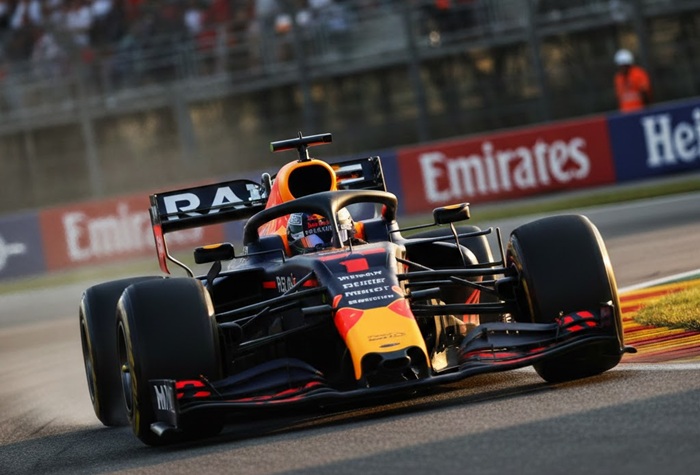
8. Red Bull RB9
The RB9’s most notable feature was its unusual stepped nose shape, which was designed by Adrian Newey and aerodynamicist Peter Prodromou for the 2013 season.
The car was equipped with a 2.4-liter Renault RS27-2013 V8 engine producing 750 horsepower.
With its distinctive aerodynamic wing and rear design, the vehicle dominated the 2013 season.
Driven by Sebastian Vettel and Mark Webber, the RB9 has won 11 pole positions, 12 fastest laps, 13 races, and 28 podiums that season helping Red Bull win its fourth Drivers and Constructors title.
9. Brabham BT52 1983
The Brabham BT52 was the first turbocharged Formula One vehicle to win a World Drivers’ Championship.
The BT52 was equipped with a 1.5-liter turbocharged inline four-cylinder BMW M12/13 engine capable of 1000bhp in qualifying trims.
Driven by Nelson Piquet and Ricardo Patrese, the BT52 went on to win four races, two pole positions, and four fastest laps that season.
Crowning Piquet as the very first turbo-powered F1 champion and assisting him in winning his second career title.
10. Ferrari 125 F1
Scuderia Ferrari’s first Formula 1 car was the Ferrari 125 F1. When it debuted on the Piacenza racing track on May 11, 1947, it was the first car to wear the Ferrari brand.
Equipped with a 1.5-liter engine manufactured in 1947 by Ferrari of Modena, Italy, was utilized by the Italian team in eight World Championship Grands Prix during the 1950 and 1951 seasons, and what makes it to this list is that there are only two of these.
Why Are F1 Cars Called Formula 1?
Formula 1 gets its name from the “formula” — a strict set of rules — that all teams and cars must follow.
When the FIA (Fédération Internationale de l’Automobile) established the championship in 1946, they created a standardized rulebook to ensure fairness, safety, and competitive balance.
This set of regulations was called Formula A, later renamed Formula 1, signifying the highest, most elite category of single-seater racing in the world.
The “formula” covers everything: engine architecture, aerodynamics, safety systems, fuel limits, materials, and even how much f1 cars weigh. The aim is simple: allow innovation, but within boundaries that keep competition tight and prevent teams from gaining unfair advantages.
Over the decades, the formula has evolved drastically. From massive V12s to turbo V6 hybrids, from simple wings to ultra-complex aero packages — every era has brought a new identity while staying true to the core rule-based structure.
The “1” represents the pinnacle — the very top tier of motorsports. There are other formulas like F2, F3, and F4, which act as feeder series, but none match the engineering intensity or global prestige of Formula 1.
This is where the world’s best drivers meet the fastest, most advanced racing machines on the planet.
And yes, those machines are fast — the top speed of f1 cars has crossed 360 km/h in certain setups, proving why this sport sits at the top of the motor-racing pyramid. Formula 1 isn’t just a name; it’s a statement of supremacy.
What Engines and Fuel Do F1 Cars Use?
Modern F1 cars use one of the most advanced power units ever created: a 1.6-liter turbocharged V6 hybrid engine.
But calling it just an engine doesn’t do it justice. It’s a combination of internal combustion, electric motors, energy recovery systems, and an incredibly intelligent control unit that works like the car’s brain.
Together, this hybrid power unit can produce over 1,000 horsepower while remaining highly fuel-efficient — a remarkable achievement for machines that push the limits of physics.
The engine works with two electric systems:
- MGU-K, which recovers energy from braking
- MGU-H, which harvests heat energy from the turbo
This recovered energy is stored in high-performance battery packs and deployed strategically during acceleration, giving F1 cars their explosive speed.
As for fuel, F1 cars run on a specialized 100% sustainable fuel blend developed under strict FIA guidelines.
While it resembles premium petrol in appearance, it’s far more advanced. It’s engineered for extreme combustion efficiency, clean burning, and maximum power delivery. The goal is to push innovation that eventually trickles down to road cars.
Despite all this sophistication, the power unit is one of the key reasons f1 cars are so expensive — each engine involves exotic materials, precision engineering, and thousands of hours of R&D.
And combined with the lightweight chassis, the hybrid engine helps explain how f1 cars weigh surprisingly little compared to their power output. The end result is a technological masterpiece capable of delivering unmatched performance on the track.

The Science Behind F1 Tires and Tyre Degradation
F1 tires may look simple from the outside, but they’re among the most scientifically advanced components on the car.
Made by Pirelli, these tires are designed not just for grip but also for controlled degradation — a feature that adds strategy, unpredictability, and excitement to every race.
At the core of each tire is a highly engineered rubber compound that reacts dramatically to heat. As the tire warms up, the rubber softens and provides intense grip, allowing drivers to corner at unbelievable speeds.
But there’s a trade-off: the hotter the tire gets, the faster it wears. This delicate balance between grip and longevity is what makes tire management such a crucial part of Formula 1.
Tyre degradation happens in several ways.
- Thermal degradation occurs when temperatures exceed the optimal window, causing the rubber to blister or overheat.
- Graining happens when the tire cools too quickly or slides on the track, building small rubber rolls that reduce grip.
- Wear degradation occurs simply through friction, gradually stripping the rubber surface layer by layer.
Teams constantly monitor tire temperatures and pressures through sensors, adjusting strategy based on real-time data. Even the track surface, weather, fuel load, and driving style influence how fast the tires degrade.
F1 tires are intentionally made to degrade differently — soft tires offer maximum grip but wear quickly, while hards last longer but need time to heat up.
This engineered variety ensures that races are not just about raw speed but also about tactics, timing, and precision driving.
Other related FAQs: About the top F1 cars
Which is the fastest F1 car?
The title of the fastest F1 car often goes to the Mercedes W11 from 2020, thanks to its incredible aerodynamic efficiency, powerful hybrid engine, and revolutionary DAS system. It reached record-breaking speeds on multiple circuits and dominated the season with unmatched performance.
While raw top speed varies across eras, the W11’s combination of cornering speed, acceleration, and overall lap-time superiority makes it widely regarded as the fastest and most complete Formula 1 car ever built.
Which are the best-looking F1 cars of all time?
Beauty in F1 is subjective, but a few designs consistently top fan and expert lists. The Ferrari F2004, McLaren MP4/4, Jordan 191, Lotus 79, and Mercedes W11 are often praised for their clean lines, perfectly balanced proportions, and purposeful aero shapes.
These cars blend aesthetics with engineering harmony, creating silhouettes that still stand out decades later. Whether it’s Ferrari’s iconic red curves or the sleek black-and-silver McLarens, these machines prove that speed and beauty can coexist effortlessly.
Who is the most attractive and stylish Formula 1 driver?
Style and attractiveness are personal, but Lewis Hamilton is widely considered the most stylish driver in Formula 1 history. Beyond his seven world titles, he’s known for bold fashion choices, designer collaborations, and red-carpet presence that rivals Hollywood celebrities.
Many fans also highlight drivers like Charles Leclerc and Carlos Sainz for their polished looks and effortless charm. But Hamilton’s confidence, individuality, and trend-setting wardrobe make him the standout when it comes to blending racing talent with global style appeal.
Conclusion
In its rich history, Formula 1 has seen many cars burn the tracks. We’ve compiled a list of the finest of them all.
From ground-effect marvels to hybrid-era dominators, each car pushed the boundaries of what was thought possible, inspiring the generation that followed.
And while the technology keeps evolving, the legacy of these icons remains untouchable. They are benchmarks in speed, innovation, and pure racing spirit.
If you think that there are other cars that need to be listed here please contact us and we will do our best to update the article ASAP.

A car is a wheeled, self-powered vehicle used for transportation. Most definitions of cars say that they run primarily on Read more
Carrozzeria Ghia is a car and bodywork design company founded by Giacinto Ghia and Gariglio as Carrozzeria Ghia in 1916 Read more
If speed had a face, it would probably wink at you from behind the wheel of a Nissan. From zipping Read more
Triumph has produced some of the most iconic sports cars over the years. From the 1800 and 2000 Roadsters of Read more

Based in Orem (Utah) John Paterson graduated from Utah Valley University and has begun writing in 2009. He has a large wealth of experience in writing articles related to cars, automotive repair, wheels, cleaning/maintenance, and much more. He has also written instructional articles in a similar niche for a few online publications as well. Currently, he works as a mechanic in his personal garage shop where he loves serving his countrymen from his heart.