
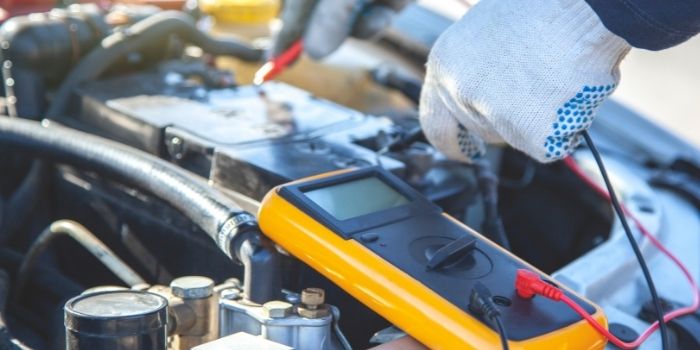
An automotive test light, also known as the main tester, test lamp, or voltage tester, is an electrical gadget that is used to check the existence of electricity in your vehicle’s circuits.
Understanding how to utilize a test light is a skill that will come in helpful at some moment.
So, what’s the point of a test light, and why should you keep one in your car?
In this guide, we’ll break down the different types of automotive test lights, explain when and how to use each, and share smart buying tips so you can pick the right tool with confidence, not guesswork.
Understanding Test Lights
Pop the hood of any car and you’ll find miles of wiring, dozens of connectors, and enough electrical gremlins to ruin an otherwise perfect day.
That’s where the humble automotive test light quietly earns its keep.
It’s one of the simplest tools in a mechanic’s arsenal, yet it can save hours of guesswork when tracking down blown fuses, dead circuits, bad grounds, or mysterious no-start issues.
Whether you’re a seasoned technician, a weekend DIYer, or someone who just wants to avoid paying a shop for a five-minute diagnosis, a good test light is like a flashlight for your car’s nervous system.
It is simple to use, affordably priced, and widely available in most hardware and parts shops, so you don’t feel helpless when it’s time to perform car repairs and conduct electrical power and grounding tests.
Different Types of Automotive Test Lights
Automotive electrical diagnostics aren’t one-size-fits-all—and neither are test lights.
Understanding the different types available is the first step toward choosing the right tool for the job, instead of poking wires and hoping for the best.
Some test lights are designed for quick, basic checks, while others can handle more advanced electrical diagnostics.
Below are the most common types of automotive test lights and electrical testers you’ll encounter, along with what they’re actually good at.
1. Non-Contact Voltage Testers
Non-contact voltage testers allow you to detect the presence of voltage without physically touching exposed wires or terminals. They sense the electromagnetic field created by AC voltage and alert you via a light or audible beep.
These testers are battery-powered, extremely easy to use, and excellent for quick safety checks.
However, they typically work only with AC voltage and are not reliable for detailed automotive DC diagnostics—so think of them as a quick “is it live?” tool, not a precision instrument.
2. Neon Voltage Testers
Neon test lights are among the simplest electrical testers available. They indicate the presence of voltage using a small neon bulb that illuminates when current flows.
Because they require direct contact with the circuit, caution is essential during use.
They do not measure voltage levels or current flow—only whether voltage is present—making them suitable for very basic diagnostics and little else.
3. Plug-In Circuit Testers
These testers are commonly used for checking socket wiring and basic circuit integrity.
They typically feature three neon lights that illuminate in different combinations, each pattern corresponding to a specific wiring condition.
The results are easy to interpret, often printed directly on the tester body. While convenient, plug-in circuit testers are limited in scope and are best suited for quick checks rather than in-depth troubleshooting.
4. Continuity Testers
Continuity testers are battery-powered tools used to determine whether a circuit is complete or broken. When continuity exists, the tester lights up or emits a tone, confirming that current can flow from one point to another.
Some advanced versions include LED indicators or simple digital displays.
These testers are invaluable for diagnosing broken wires, blown fuses, faulty switches, or poor connections—especially when voltage testing alone doesn’t tell the whole story.
5. Multimeter
The age-old debate: multimeter vs. test light. While both can detect voltage, a multimeter is far more versatile.
A multimeter can measure voltage (AC and DC), current, resistance, and continuity—all selectable via a rotary dial.
When used correctly, it provides precise numerical data about sensors, batteries, alternators, and other automotive components.
In fact, once you own a good multimeter, you’ll likely find yourself relying less on individual test lights, as it can perform many of the same tasks—and then some.
6. Solenoid Voltage Tester
Solenoid voltage testers are designed for multiple testing functions and, unlike many testers, do not require batteries. They operate by drawing power directly from the circuit under test.
These testers indicate voltage presence—and often relative voltage levels—through mechanical movement, clicking sounds, or vibration.
They’re affordable, durable, and particularly useful for testing starter circuits, relays, and solenoids in automotive systems.
7. Clamp Meter
A clamp meter combines multimeter functionality with the ability to measure current without breaking the circuit.
By clamping around a wire, it detects the magnetic field generated by current flow.
Although more expensive than standard test lights, clamp meters are safe, efficient, and easy to use—especially when diagnosing parasitic draws, alternator output, or high-current circuits.
For serious automotive electrical work, it’s a tool well worth the investment.

LED vs. Incandescent Test Lights for Cars
When it comes to diagnosing automotive electrical problems, choosing between LED and incandescent test lights can make your job either smooth and precise—or unnecessarily risky.
While both tools serve the same basic purpose, their behavior in real-world vehicle circuits is very different.
Key differences explained
Incandescent test lights use a small filament bulb that draws relatively high current from the circuit being tested.
This current draw makes them ideal for checking circuit load capacity. If an incandescent light glows bright, you know the circuit can handle real-world current demands.
That’s why many technicians still rely on them when testing starter circuits, relays, or grounds—especially in older vehicles.
A heavy-duty test light with an incandescent bulb can even reveal weak connections that an LED might miss.
LED test lights, on the other hand, draw very little current. They’re extremely sensitive and light up even with minimal voltage present.
This makes them safer for modern vehicles loaded with ECUs, sensors, and low-current control circuits.
LED models are excellent voltage testing lights for checking fuses, signal wires, and control modules without risking damage.
However, their low current draw means they can’t always tell you if a circuit can handle a load—only that voltage exists.
Which one should you use?
If you work primarily on modern cars, LED test lights are the smarter choice. They’re safer, faster, and less likely to harm delicate electronics.
For older vehicles, or when diagnosing high-current circuits, an incandescent option is still invaluable.
Many professionals keep both in their toolbox, along with specialized wire test lights for tracing and continuity checks.
| Feature | LED Test Light | Incandescent Test Light |
|---|---|---|
| Current Draw | Very low | High |
| Safe for ECUs | Yes | Risky on sensitive circuits |
| Detects Weak Circuits | Limited | Excellent |
| Best Use | Modern vehicles, sensors, fuses | High-current circuits, grounds |
| Durability | Long-lasting | Bulb can burn out |
How to Use a Test Light Car Circuit Tester Correctly
Knowing how to utilize a test light can assist you in detecting when critical electrical components have failed.
Because test lights may be used for a variety of purposes, we will describe how to utilize one in these instances.
Positive voltage examination
The first step is to ensure that the test light is operational. This would need to connect the test light to a known ground source.
A ground source in this context refers to exposed metal elements of the car’s chassis. You might also utilize the negative end of the battery.
Touch the probe gently to a source of positive voltage, such as a fuse or the positive terminal of a vehicle battery. If the test light illuminates, it is in excellent working order.
The next step is to go through the same procedure you used to test the test light.
The main difference is that after connecting to a ground source, you connect to the end of the wire or component being tested for positive voltage.
If the tool lights up, this indicates that there is some positive electricity present. If it doesn’t, the component has failed and has to be cleaned or replaced.
Using a test light to check fuses
You may use a test light to see whether any of your car’s fuses are energized. Here are the measures to take.
Locate the fuse box panel in your vehicle. You may need to consult the owner’s handbook to do this.
Once you’ve done so, remove the cover to reveal the fuses.
Before you begin, make sure your vehicle is not turned on.
The test light’s clip is then clamped to a good ground source, such as a metal surface of the vehicle that is not painted (like a bolt, for instance).
The battery’s negative terminal is likewise an excellent replacement. It all depends on where the fuse box panel is located in the vehicle.
The next step is to utilize the list of fuses on the inside of the cover to determine which fuse needs to be checked.
After that, place the probe of the test light into one of its holes to test it. The test light will illuminate if the fuse is operational. If it doesn’t, the fuse is most likely faulty.
You must validate this, and to do so, you must test the second hole on the fuse.
The power input and output of the fuse are represented by both holes.
If the test light does not illuminate after checking both holes, the fuse is most likely faulty and should be replaced.
Using a test light to look for a short to ground
You may have noticed that your car has started to lose its power or accelerates inappropriately. If the issue remains after you have checked all other parts of its functioning, you should inspect the electrical system.
The goal is to determine the degree of electrical resistance, and the easiest method to do so is to inspect your vehicle’s ground circuit.
Here’s how you can do it.
- Ascertain that the positive circuit is operational. After you’ve determined this, you may test the ground circuit.
- Connect one end of the test light (ideally a circuit tester) to the positive end to do this.
- The other end of the tester is then connected to the ground wire of the component being examined.
If the test light illuminates, the ground circuit is good, and you may need to look elsewhere to determine the source of the higher resistance.

What are the Best Automotive Circuit Testers to Buy?
Do you want to discover what’s wrong with your car’s charging system or ignition?
Or are you curious as to why your brake lights aren’t working?
These issues are most likely caused by a faulty connection in the car’s electrical system. As a result, you’ll require a one-of-a-kind instrument to pinpoint the source of the problem.
Leaving you with a new problem, what is the best tool for the job? Relax. You don’t need any specialized equipment.
You just need to get a decent automotive circuit tester on the market.
1. IIT Professional 6-12V Circuit Tester
It is manufactured by IIT Corporation and is one of the greatest professional-grade tools available in the market today.
When the circuit is complete, a light in the handle lights. Because of its adaptability, it may be used to find short circuits as well as test light sockets and fuses.
It includes a 4.5-foot ground wire as well as an excellent insulated alligator clip. This gadget is ideal for detecting live and damaged wires.
The probe tip is protected by a plastic sheath on the device which prevents people from harming themselves when retrieving the instrument from the toolbox.
It’s perfect for use as a testing circuit in systems ranging from 6 to 12 volts.
Pros
- Circuit tester of the highest quality
- A lifetime warranty is included
- Extremely adaptable
- Excellent for preventative maintenance
Cons
- There are no instructions supplied
- The cord is only 4.5 feet long
2. OTC 3642 Truck Electrical Circuit Tester – 12V-24V with 24 Foot Cord
Need a test light with an extremely long cable, a huge clip, and that works on a 24-volt system?
Then this is the circuit tester that exceeds the standards we recommend for you.
It is intended for use on large vehicles such as trucks and buses because they often utilize a 12-24-volt system.
Aside from that, the rope may be extended to a length of 24 feet. Furthermore, if the bulb breaks and falls out, you may buy a replacement.
If you need a high-performance 7-inch long probe circuit tester then this one is the best option.
Pros:
- Replaceable light bulb
- The light is excellent
- The cord is extremely long and coiled
- Excellent for truck use
Cons
- On the inside, the tester may melt
3. OEMTOOLS 25887 One Hand Wire Piercing Circuit Tester
This tool is really useful when dealing with wire testing. All you have to do is puncture and let it hang up.
This tool may appear to be capable of drawing a large current, but it uses an LED that draws approximately 11 milliamps.
It operates on a 6-24 volt system, making it suitable for a wide range of automobiles.
The suggested wire type is coiled flexible wire, which may reach a length of 12 feet which is long enough to get most of the workpieces.
Oemtools 25887 is a dependable heavy-duty gadget that can identify the circuit quickly and accurately.
Pros:
- Inexpensive
- Effective
- One-handed use
Cons:
- Red LED light is ineffective
4. JASTIND Heavy Duty Automotive Premium 6-24V Test Light
Long cords must take a long time to clean, don’t they? If you agree, this JASTIND circuit tester is an excellent choice.
When extended, the coiled cable may reach a length of 11.25 feet, which is 135 inches. This is an appropriate length for an automotive test light.
You may also use it to test most things, all thanks to its sharp piercing probe and handle.
The length of the tester is 8.5 inches, and the alligator clip is 3 inches. This facilitates one-handed operating. This alligator clip may be used on both the negative and positive terminals.
This device is intended for testing systems ranging from 6 to 24 volts and you’ll also like the fact that this item comes with an indicator light for replacement.
Pros
- Long-lasting construction
- Excellent quality
- Simple to use
Cons
- For continuous testing, it may require a battery
5. Astro Pneumatic 7760 Cordless Circuit Tester
It is a lightning-fast circuit tester. It is cordless, so merely probe the workpiece or circuit to be tested, and it will light up and beep.
This is an excellent tool for testing technology in the inside automobile, such as the dash.
Unlike the other test lights, this one has an internal power supply (a typical AA battery). As a result, this one is usually computer-safe.
If you want the best circuit tester that is safe for airbags and ECM, this is the one for you.
It may be used for a variety of systems since it operates on a voltage range of 3 to 28 volts. You might think it’s pricey.
This one is reasonable, has a long-lasting battery, and is a must-have tool. It is also an economical choice for electricians and technicians.
Furthermore, the V-tip makes it simple to puncture the wire that has to be examined.
Pros:
- Excellent value
- Excellent quality
Cons:
- Imprecise
6. General Technologies Corp GTC CT8002 Cordless Circuit Tester
It is Astro’s direct opponent. They appear to have a similar design.
When the probe contacts the positive spot, it emits an LED light, an audio beep, and vibration. A V-tip is also intended for simple piercing.
This tester made in Canada consumes just 20 microamps of current and for the safety of your airbag and ECM, it’s highly recommended as this model is cordless.
It has a voltage range of 3 to 28 volts and deserves to be in your toolkit for a variety of applications. It may be carried in your pocket as needed.
This circuit tester is a rapid-issue solution for checking the live voltage without having to pull out your multimeter.
Pros:
- The cordless makes it easy to handle.
Cons:
- The accuracy isn’t fantastic
7. KZYEE KM10 Power Circuit Probe Kit
This instrument can do practically every service from continuity testing, ground checking, troubleshooting circuits, measuring MAX/MIN voltage, or even activating automobile components this product will take care of it for you.
Unlike many others, this accurately analyses resistance, diode, DC voltage, ad 12-24 volt systems’ AC voltage.
Even better, you only need to hit the mode button to do so.
You can quickly power it up and can reach practically every component of your trailer, truck, or automobile all thanks to its 20-foot cable.
The item is also equipped with a spotlight that lits around the working area.
Pros
- Equipped with plenty of functions
Cons
- You may require some expertise to better use it
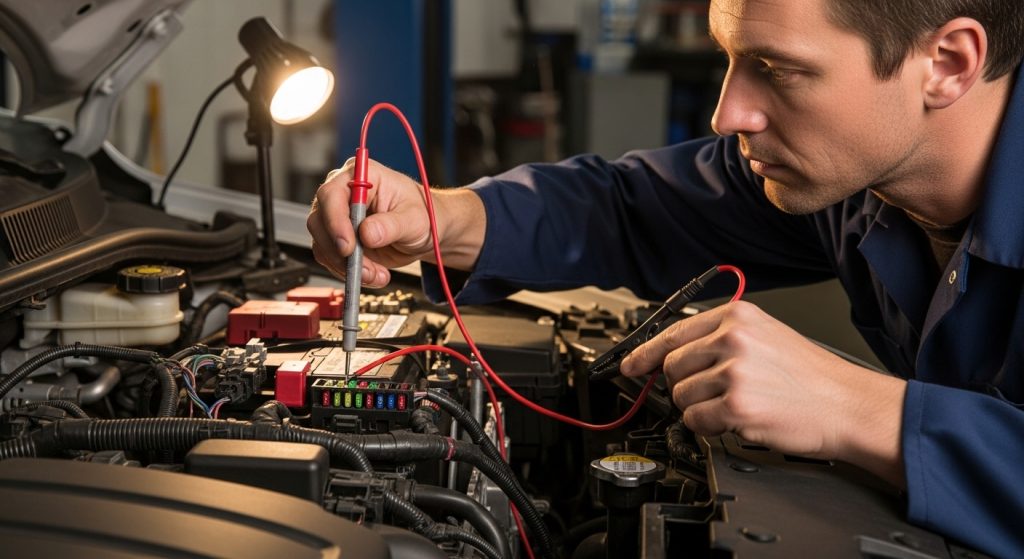
What to Look for in an Automotive Circuit Tester when Buying?
Since there are so many versions of automotive test lights to diagnose all of your car’s electrical issues on the market, selecting the ideal product may be difficult.
Knowing that we have compiled a list of tips that will help you pick the right automotive circuit testers available online.
There’s no chance you won’t discover the ideal one for your needs here.
a) Length of the Cable
Long cables, as opposed to small ones, are preferable since they reach the majority of regions.
But they do have significant drawbacks. For example, they take up too much space and are difficult to clean. Hence, I recommend purchasing circuit testers with coiled cables for ease of handling and storage.
b) Voltage range
Take into account the voltage of the car wiring and circuits you plan to examine. This will allow you to select the best device for the job.
For example, if you have a hybrid vehicle with a 24V system, utilizing a 6-12 Volts unit will not be realistic. However, we have one easy recommendation: get the most adaptable circuit tester with a wide range of voltage.
c) Safety
A quality electrical test light should protect you from current overload while keeping safety front and center. Proper insulation is non-negotiable—especially when working around live circuits.
Look for models with well-insulated probes and rubberized sleeves that reduce the risk of accidental contact with energized components.
These designs also help dampen vibration during use, giving you better control, improved grip, and more accurate readings when working in tight or high-vibration automotive environments.
d) Durability and Price
Look for elements that ensure a long life. Begin with strong cables, high-quality construction, and a shutter-proof arrangement. Warranties must also be viewed as evidence of quality.
Additionally, there is no reason to overpay for a product that does not provide any additional benefits or features.
But keep in mind that in addition to pricing, examine the features, limits, and advantages of circuit testers. Only then will you obtain the most affordable product.
Conclusion
Test lights are very useful equipment to have in your toolbox. Knowing how to utilize a test light is an essential skill for anybody who owns or operates a car. This is because it makes it simple to determine the car’s electrical system and its components.
Also, there are several types and brands of test lights on the market. Because everyone’s preferences are different, we didn’t choose a single product to suit everyone.
Instead, we’ve compiled a detailed list of the top 7 best automotive circuit testers currently on the market.
So, feel free to look through the features, benefits, and drawbacks of each test light and then choose the one that best suits your needs.
Hopefully, with the above products and tips, the next time your automobile develops a defect, you should be able to utilize your test light to rule out some of the more unlikely sources of the issue.

If your car wheels have lost their sparkle or you’re just itching to give your ride a fresh, custom edge—spray Read more

If you're new to car repair projects or just looking for a better way to complete them, you might be Read more

If you're like most people, you probably think of Lamborghinis when you hear the word "Lambo doors." But did you Read more

Today, you will find the most adventurous bikers and professional riders carrying their bikes for longer distances when they travel. Read more

Based in Orem (Utah) John Paterson graduated from Utah Valley University and has begun writing in 2009. He has a large wealth of experience in writing articles related to cars, automotive repair, wheels, cleaning/maintenance, and much more. He has also written instructional articles in a similar niche for a few online publications as well. Currently, he works as a mechanic in his personal garage shop where he loves serving his countrymen from his heart.