
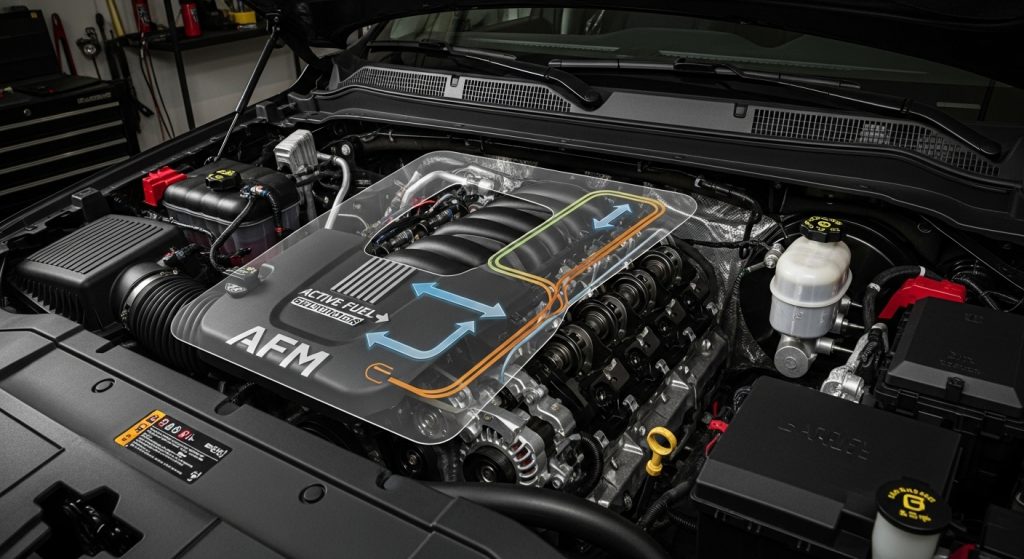
Modern engines are smarter than ever. They shut off, wake up, adjust timing, and change personalities faster than most drivers notice.
One of the most talked-about examples of this “thinking engine” era is Active Fuel Management (AFM) — a technology that promises better fuel economy without sacrificing power.
On paper, AFM sounds brilliant. Why burn fuel in eight cylinders when you only need four to cruise down the highway?
In practice, however, the story is more complicated — especially for long-term owners of certain GM V8 vehicles.
Some drivers swear by AFM, praising smoother highway mileage and lower fuel costs.
Others consider it a ticking mechanical time bomb, blaming it for engine failures, oil consumption, and expensive repairs. Somewhere between those two extremes lies the truth.
In this in-depth guide, we’ll break down how Active Fuel Management works, why manufacturers use it, what benefits it offers, and the real-world problems owners face.
We’ll also help you identify whether your vehicle has AFM, what warning signs to watch for, and how to make informed decisions if you’re already living with it.
Let’s get under the hood.
Understanding Active Fuel Management
Active Fuel Management is a cylinder deactivation technology designed to improve fuel efficiency in internal combustion engines.
Basically, the system works by turning off some of the cylinders when they are not needed.
Under light-load driving conditions — such as steady highway cruising — the engine temporarily shuts down specific cylinders, reducing fuel consumption without requiring driver input.
AFM is most commonly associated with General Motors (GM) and its V6 and V8 engines, although similar systems exist under different names across the industry.
At its core, the active fuel management system allows the engine to switch seamlessly between full-cylinder operation and reduced-cylinder operation based on driving demand.
Which Vehicles Typically Have AFM?
AFM is mainly found in:
- Full-size pickup trucks
- Large SUVs
- Performance sedans with V8 engines
Vehicles that benefit most from AFM are heavier platforms that spend a lot of time cruising at constant speeds — where full engine output isn’t necessary.
Manufacturers That Use AFM-Style Technology
While the term “AFM” is GM-specific, similar technologies include:
| Manufacturer | Technology Name | Common Applications |
|---|---|---|
| General Motors | Active Fuel Management | Trucks, SUVs, V8 sedans |
| GM (newer models) | Dynamic Fuel Management (DFM) | Advanced V8 platforms |
| Honda | Variable Cylinder Management (VCM) | V6 sedans & SUVs |
| Chrysler | Multi-Displacement System (MDS) | HEMI V8 engines |
| Volkswagen | Active Cylinder Technology (ACT) | Turbocharged engines |
Among these, GM’s AFM has gained the most attention — and criticism — largely due to its widespread use and long production run.
What Does Active Fuel Management Do in Cars?
The primary goal of AFM is simple: reduce fuel consumption when full engine power isn’t needed.
During light throttle input, the system deactivates certain cylinders, allowing the engine to operate as a smaller displacement unit.
Once more power is required — acceleration, climbing, towing — the system instantly reactivates all cylinders.
How AFM Improves Efficiency
AFM improves fuel economy by:
- Reducing fuel injection to inactive cylinders
- Closing intake and exhaust valves on those cylinders
- Minimizing pumping losses
- Lowering internal friction
The engine effectively “shrinks” during cruising and “grows” when demand increases.
Real-World Benefits for Drivers
In ideal conditions, drivers may notice:
- Improved highway MPG
- Reduced fuel costs over time
- No noticeable loss of performance
- Seamless transitions between modes
For many owners, especially those with newer models, the active fuel management functions operate quietly in the background without ever drawing attention.
How Does AFM Actually Work? (The Mechanical Side)
Understanding AFM requires a look at some key components.
Key AFM Components
- AFM lifters – Special hydraulic lifters that collapse to disable valve movement
- Oil control solenoids – Direct oil pressure to activate or deactivate lifters
- Engine Control Module (ECM) – Decides when AFM engages
- Sensors – Monitor load, speed, throttle position, and temperature
How Does AFM Lifter Work?
During AFM operation, oil pressure is redirected to special lifters.
These lifters collapse internally, preventing the camshaft from opening the valves. With the valves closed and fuel cut off, the cylinder becomes inactive.
This process happens in milliseconds — and ideally without the driver ever noticing.
However, this same complexity is also where many long-term reliability concerns originate.
The Real Problems of Active Fuel Management in Vehicles
This is where AFM’s reputation becomes controversial.
While the concept is solid, real-world usage has exposed weaknesses — especially in older GM V8 engines.
Some of the most reported problems and active fuel management issues include:
- Excessive oil consumption
- Collapsed or stuck lifters
- Engine misfires
- Rough idle or vibration
- Sudden loss of power
- Check engine lights
Many technicians and owners agree that AFM lifters are the real problem, not the software logic itself.
Engines frequently discussed in owner complaints include: 5.3L V8, 6.0L V8, and 6.2L V8.
The GM 5.3 AFM problems are especially well documented, often tied to long oil change intervals or poor oil quality.
Typical warning signs and AFM lifter failure symptoms include:
- Ticking or knocking noises
- Engine shaking at idle
- Misfire codes on specific cylinders
- Loss of power during acceleration
Left unaddressed, these symptoms can escalate into major engine damage.

Is Active Fuel Management Technology Bad for Engines? Should You Disable AFM?
Short Answer: Not Inherently — But It Depends
AFM itself is not automatically harmful. When properly maintained and driven under ideal conditions, many engines exceed 150,000 miles without serious issues.
Problems typically arise due to:
- Poor oil quality
- Extended oil change intervals
- High heat and sludge buildup
- Repeated AFM activation cycles
From a mechanical standpoint, AFM introduces additional stress points — especially in the valvetrain.
Engineering Trade-Offs
AFM is a classic example of efficiency vs. simplicity.
- More parts = more potential failure points
- Tighter tolerances = higher maintenance sensitivity
This is why many enthusiasts view afm active fuel problems as a design compromise rather than a defect.
Active Fuel Management – Pros and Cons
| Aspect | Pros | Cons |
|---|---|---|
| Fuel Efficiency | Improves highway MPG by deactivating unused cylinders | Gains are minimal in city or stop-and-go driving |
| Engine Operation | Seamless transition between cylinder modes under light load | Added complexity in lifters and valvetrain |
| Performance | No noticeable loss of power during normal cruising | Can feel inconsistent during frequent mode switching |
| Maintenance | No extra service required when system is healthy | Highly sensitive to oil quality and change intervals |
| Long-Term Ownership | Helps reduce fuel costs over time | Repairs can be expensive if lifters or camshaft fail |
AFM by Vehicle Model: What Owners Report and Should You Disable AFM?
AFM issues tend to appear more frequently in certain model years and platforms.
Owners of full-size trucks report problems more often, likely due to higher mileage, towing loads, and longer ownership cycles.
For example:
- Chevy Silverado models from specific years are commonly mentioned in forums
- Heavy-duty variants have also raised concerns, including reports of Chevy Silverado 2500 afm problems
Discussions around Chevy AFM problems for years often point to earlier implementations rather than newer refinements.
Disabling AFM doesn’t repair mechanical damage — it simply prevents further activation.
An active fuel management disabler is an aftermarket device that prevents the system from engaging by modifying ECM signals.
Pros of Disabling AFM
- Eliminates lifter cycling
- Smoother engine operation
- Reduced long-term wear
Cons of Disabling AFM
- Slight reduction in fuel economy
- Potential warranty concerns
- Not a fix for already damaged components
Related FAQs
Should I Avoid AFM-Equipped Vehicles?
AFM is not inherently bad for engines, and many vehicles run well for years with proper maintenance.
However, some engines have shown oil consumption and lifter wear issues, largely due to design complexity.
Disabling AFM is generally safe but won’t fix existing damage and may affect warranties.
Newer AFM and Dynamic Fuel Management systems are more refined, so buying an AFM-equipped vehicle isn’t a deal-breaker—maintenance history matters most.
How Can I Confirm Whether My Car Has AFM?
The most reliable way to confirm AFM is by checking your vehicle’s engine RPO codes, especially in GM vehicles, where specific codes indicate AFM capability.
You can also verify it through the owner’s manual, a diagnostic scan tool, or by consulting a dealership or manufacturer service database.
If you’re shopping used, following an active fuel management checklist before purchase can help you avoid unexpected repair bills down the road.
What Should I Do If I Suspect Active Fuel Management Problems?
If you suspect AFM-related issues, start with basic active fuel troubleshooting. Check the engine oil level and condition, as AFM systems are highly oil-dependent.
Scan for misfire or lifter-related trouble codes, listen for abnormal valvetrain ticking or knocking, and monitor any sudden drops in fuel economy or rough idle.
Catching these symptoms early can prevent minor AFM faults from turning into expensive engine repairs.
Final Thoughts: AFM is neither a hero nor a villain
Active Fuel Management is a smart idea executed with mixed real-world results. For drivers who prioritize fuel efficiency and follow strict maintenance schedules, AFM can be a quiet, invisible ally.
For others — especially long-term owners of older GM V8s — it can become an expensive headache.
The key takeaway is awareness. Understanding how AFM works, recognizing early warning signs, and making informed decisions — whether that’s maintenance, disabling, or avoiding certain model years — puts control back in the driver’s seat.
AFM isn’t inherently bad engineering. It’s just engineering that demands respect.

I know people who love their recreational vehicles (RVs) and treat them like a second home. Usually, they take their Read more

When you're driving on the freeway, and you pass 60 mph, your car starts to shake. You may have wondered Read more

If you’ve ever heard car enthusiasts talk about “unlocking hidden horsepower” or “waking up the engine,” chances are they’re referring Read more

There are few things more unsettling than glancing down at your dashboard and seeing the needle behave like it’s had Read more

Based in Orem (Utah) John Paterson graduated from Utah Valley University and has begun writing in 2009. He has a large wealth of experience in writing articles related to cars, automotive repair, wheels, cleaning/maintenance, and much more. He has also written instructional articles in a similar niche for a few online publications as well. Currently, he works as a mechanic in his personal garage shop where he loves serving his countrymen from his heart.