
There are few things more unsettling than glancing down at your dashboard and seeing the needle behave like it’s had too much coffee.
One moment it’s steady. The next, it climbs. Then it drops. Then it climbs again.
When your temperature gauge go up unexpectedly—or worse, keeps bouncing around—you’re not just looking at a quirky instrument.
You’re potentially witnessing the early signs of a cooling system issue that could lead to overheating, engine damage, or expensive repairs.
The good news? In most cases, a fluctuating temperature gauge is both diagnosable and fixable—often without replacing half your engine bay.
In this guide, we’ll break down:
- How your temperature gauge actually works
- Why your readings may be unstable
- 7 practical ways to fix it (even while driving)
- How to properly diagnose the issue before throwing parts at it
Let’s get under the hood—figuratively and literally.
Understanding the Car Temperature Gauge
Your car’s temperature gauge is a simple visual representation of a complex thermodynamic process happening inside your engine.
Modern vehicles use an Engine Coolant Temperature (ECT) sensor that monitors the temperature of the coolant circulating through the engine.
This data is sent to the Engine Control Unit (ECU) and the instrument cluster (where the gauge lives).
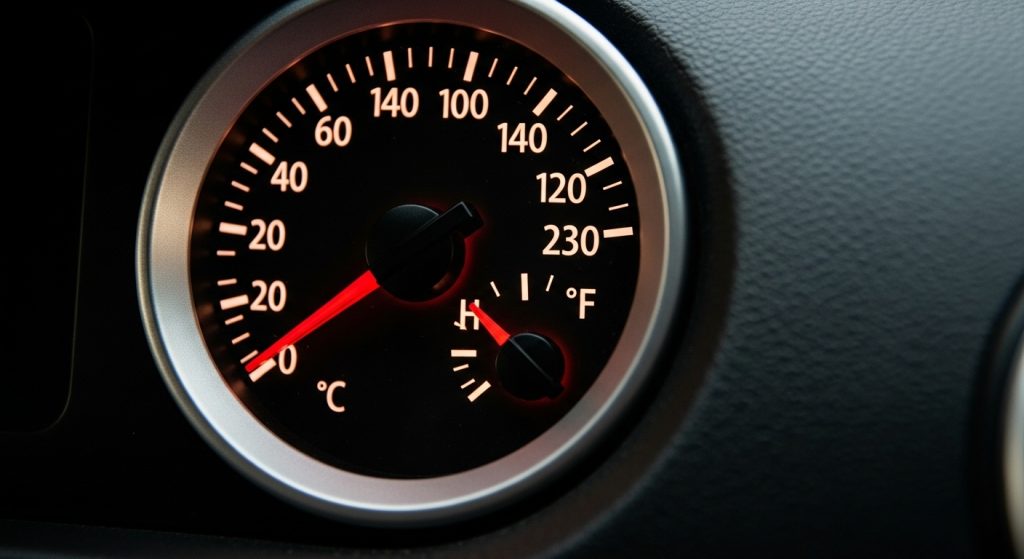
The auto engine coolant temperature gauge typically displays:
- Cold (C) – Engine not yet warmed up
- Normal range – Usually around 195°F to 220°F (90°C–105°C)
- Hot (H) – Risk of overheating
In most cars, once warmed up, the needle should stay nearly steady. Minor movement is normal during long uphill climbs, towing, heavy traffic, high ambient temperatures, etc.
However, if the engine temperature fluctuates while driving under normal conditions, something isn’t behaving as it should.
The cooling system itself consists of a radiator, thermostat, water pump, coolant, radiator fan, temperature sensors, hoses, and pressure cap. Any weak link in this chain can cause unstable readings.
Why Your Car’s Temperature Gauge Goes Up and Down?
When car temperature gauges going up and down become frequent, it’s rarely random. Cooling systems are designed to regulate temperature within a tight operating band.
In most cases, fluctuations point to one of three core issues: flow problems, air pockets, or faulty measurement.
First, flow disruption. Coolant must circulate smoothly from the engine to the radiator and back.
If the thermostat sticks, the water pump weakens, or there’s a partial blockage in the radiator, coolant flow becomes inconsistent.
The result is that the gauge rises as heat builds, then drops once flow resumes.
Second, air in the cooling system. Air pockets interrupt circulation and prevent consistent temperature readings.
This often happens after coolant replacement or due to a small leak. Air expands when heated, causing erratic spikes and drops.
Third, sensor or electrical issues. A failing temperature sensor or wiring problem can cause false readings, making it appear as if your coolant temperature gauge fluctuating is a mechanical issue when it’s actually electronic.
Understanding the root cause is critical before you start replacing parts.
How to Fix a Fluctuating Temperature Gauge While Driving?
If you notice the needle acting up while driving on the road, don’t panic. Here are seven practical steps you can take.
1. Turn Off the Air Conditioning
Your A/C compressor adds extra load to the engine. If the temperature starts climbing, switch off the A/C immediately.
This reduces engine strain and heat production. In many cases, you’ll see the needle stabilize within minutes.
It’s a simple step—but surprisingly effective when heat buildup is the issue.
2. Turn On the Heater
Yes, even in summer.
Your heater core acts as a secondary radiator. Turning the heater to maximum and fan to high helps draw excess heat from the engine.
If your engine temperature fluctuates while driving, this can temporarily stabilize temperatures until you reach a safe stop.
You may sweat—but your engine won’t.
3. Check Coolant Level (When Safe)
If the temperature gauge drops while driving and then spikes again, low coolant may be the culprit.
Pull over safely. Wait at least 20–30 minutes before opening the hood. Never remove the radiator cap when hot.
Check the coolant reservoir level. If it’s low, top it off with the correct coolant mixture.
Low coolant often causes inconsistent readings due to air entering the system.
4. Inspect for Visible Leaks
Look under the vehicle for:
- Puddles (green, orange, pink fluid)
- Steam
- Dripping hoses
A small leak may not cause immediate overheating, but it will cause unstable readings as pressure drops.
Temporary fix: Add coolant to reach home—but schedule repair immediately.
5. Monitor While Driving on Highways
If the issue appears mainly during driving on highways, airflow may temporarily compensate for a weak radiator fan.
If temperature drops at highway speeds but rises in traffic, suspect:
- Faulty radiator fan
- Fan relay
- Temperature switch
Keep moving if safe—but avoid heavy traffic until fixed.
6. Gently Rev the Engine at Idle
If stuck in traffic and temperatures creep up, lightly revving the engine can improve water pump circulation.
This increases coolant flow and fan speed (on some vehicles).
It’s not a long-term fix—but it can prevent overheating in stop-and-go traffic.
7. Pull Over Before It Overheats
If the needle approaches the red zone, pull over immediately.
Continuing to drive with an overheating engine can cause:
- Warped cylinder heads
- Blown head gasket
- Cracked engine block
Let the engine cool fully before proceeding. Prevention here saves thousands.
How to Diagnose Temperature Gauge Fluctuations in Your Car When Driving?
When your engine temperature fluctuates while driving, resist the urge to immediately replace the thermostat or sensor.
Cooling systems are interconnected, and guessing can get expensive fast. A structured diagnostic approach will help you isolate the real issue—mechanical, electrical, or airflow-related.
Here are five detailed steps to properly diagnose the problem.
1. Scan for trouble codes and monitor live data
Start with an OBD-II scanner. Even if your check engine light isn’t on, stored or pending codes may reveal issues with the Engine Coolant Temperature (ECT) sensor or thermostat performance.
Common codes include P0115–P0119 (ECT circuit faults) or P0128 (coolant temperature below thermostat regulating temperature).
But don’t stop at codes—monitor live data while driving on the road. Compare real-time coolant temperature readings with dashboard behavior.
If the scanner shows a stable temperature while the gauge fluctuates, the problem may lie in the instrument cluster or wiring.
If both fluctuate together, the issue is likely mechanical (coolant flow, thermostat, air pockets).
This step separates sensor errors from true overheating conditions.
2. Evaluate warm-up behavior from a cold start
A healthy engine should warm up steadily and reach operating temperature within 5–10 minutes (depending on climate). Watch the gauge from a cold start:
- If it climbs quickly, drops, then climbs again, suspect a sticking thermostat.
- If it takes excessively long to warm up, the thermostat may be stuck open.
- If it spikes suddenly within a few minutes, airflow or coolant flow may be compromised.
Pay attention to how the heater performs. Inconsistent cabin heat often mirrors inconsistent coolant circulation.
This test is especially useful before driving on highways, where airflow can temporarily mask cooling deficiencies.
3. Check coolant level, condition, and system pressure
Low coolant is one of the most common causes of erratic readings. When coolant levels drop, air enters the system, leading to unstable temperature readings and poor circulation.
With the engine fully cooled:
- Inspect the overflow reservoir level.
- Check coolant color (it should be clean—not rusty or milky).
- Inspect for debris or oil contamination.
Next, perform a cooling system pressure test if possible. A pressure drop may indicate small leaks from hoses, radiator seams, or the water pump.
Even minor leaks can cause the coolant temperature gauge fluctuating symptom due to loss of consistent pressure.
Maintaining proper system pressure is critical because the coolant boiling point increases under pressure.
4. Inspect thermostat and coolant flow
The thermostat regulates coolant flow between the engine and radiator. When functioning properly, it opens gradually at a specific temperature (usually around 195°F).
A thermostat that sticks intermittently can cause temperature spikes followed by sudden drops—classic unstable gauge behavior.
To diagnose:
- Feel the upper radiator hose as the engine warms up. It should remain cool until the thermostat opens, then suddenly become hot.
- If it warms gradually from the beginning, the thermostat may be stuck open.
- If it stays cool while the engine overheats, it may be stuck closed.
Replacing a thermostat is relatively inexpensive, and if your auto engine coolant temperature gauge behaves unpredictably, this component is often the prime suspect.
5. Test radiator fans, water pump, and electrical connections
If temperature increases mainly in traffic but stabilizes at higher speeds, inspect the radiator fans. Fans should activate once the engine reaches operating temperature.
A faulty relay, fuse, or motor can cause overheating at idle but normal readings while driving due to natural airflow.
Next, check the water pump. Signs of failure include:
- Coolant seepage from the weep hole
- Grinding or whining noise
- Overheating at low RPM
Finally, inspect wiring and connectors leading to the temperature sensor and instrument cluster.
Corrosion, loose grounds, or damaged wiring can mimic cooling problems. In some cases, what appears to be a mechanical issue is simply an electrical irregularity affecting the gauge signal.
Final Thoughts
Your car’s cooling system is like its circulatory system—quietly doing its job until something goes wrong.
When you notice the needle behaving strangely, don’t ignore it. Most cases of coolant temperature gauge fluctuating issues stem from relatively affordable components like thermostats or sensors.
Diagnose logically. Fix promptly.
Because when it comes to engines, temperature stability isn’t a luxury—it’s survival. And your engine? It prefers steady, not dramatic.

When it comes to hiding scratches and dirt, a few colors stand out. We’ve all been there. You take your Read more

I know people who love their recreational vehicles (RVs) and treat them like a second home. Usually, they take their Read more
The speed limiter is a device that is installed on the vehicle to limit its maximum speed. This is usually Read more

If you’ve ever heard car enthusiasts talk about “unlocking hidden horsepower” or “waking up the engine,” chances are they’re referring Read more

Based in Orem (Utah) John Paterson graduated from Utah Valley University and has begun writing in 2009. He has a large wealth of experience in writing articles related to cars, automotive repair, wheels, cleaning/maintenance, and much more. He has also written instructional articles in a similar niche for a few online publications as well. Currently, he works as a mechanic in his personal garage shop where he loves serving his countrymen from his heart.